Thursday, 1 July 2010

Missing links

Missing links
https://photos.app.goo.gl/LJtLSDQkwruES7VDA

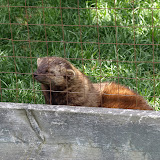
We've missed allsorts of things this holiday but here is a Fisher!  Definitely what we saw at Fort Anne. 

Today we missed the tidal bore at Truro - quite a few hours too early.  We missed the Mi'qmac (1st nation) interpretive centre just outside Truro because we ended up on the wrong road (poor signposting yet again).  We did find Victoria Park in Truro though and survived walking the Hemlock Trail (Hemlock is a tree in Canada) and we also walked part of the heritage architecture walk - Truro again.

Once on the wrong road out of Truro we found The Provincial Wildlife Park and pulled in to eat our lunch.  Then we thought we might as well go and have a look at the wildlife imprisoned here.  The weather was considerably better by this time.  We didn't miss the Linx but missed photographing it as it was lying in long grass the other side of its compound.  Also the bobcats, wolves and otters proved to difficult to photograph.  Then we found the fisher (a lady called Barbie!) and our trip was complete!

Now we're in Halifax, at Shubie Campground, 2km up the road from the Canadream rental depot.  We  had a quick walk in Shubie Park, had a look at a swimming beach on Lake Charles where people were actually swimming (weather warming up a bit at last|) and saw the old canal which was to have linked Halifax to the Fundy Shore for freight but its usefulness was overtaken by the railway.

We have eaten our supplies so had to walk 1/2hr to the nearest restaurant where we were presented with enormous rib-eye steaks. 

I'm writing this putting off the cleaning and packing up -perhaps it can all wait til the morning!

Tuesday, 29 June 2010

Watery subjects

Watery subjects
https://photos.app.goo.gl/ZXbVbPCH4V3H7Ba67

The weather has deteriorated in Nova Scotia and it rained heavily all day yesterday.  We did not return to Halifax to see the Queen but, if you saw any tv news coverage it would have shown wet weather outfits and umbrellas.  We are, however, on our way back to Halifax, currently back on the Fundy shore north of the Minas Basin at 5 Islands Campground.  We are hanging around a bit this morning hoping for a weather improvement to try to see the 5 Islands through the mist.  One more night tonight and then we'll be back to a Halifax campground for Wednesday night to hand the truck back early Thursday.

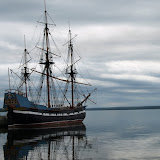
Since our last post we saw the Hector at Pictou but the boat, museum and its wharf were 'Closed until further notice'.  Then we stopped at Brule Point, still on the Northumberland Shore.  This was an unexpected pleasure.  Seals on the rocks in the distance, we could see them from our pitch!  It was magical.  We tried to walk out towards them over the beach and rocks but the nearer ones took one look at us and dived into the sea unfortunately.  Eventually there were about 24 in a group on a further rock and they stayed there for hours until the incoming tide forced them to swim off.

Yesterday the weather was a wash out.  We drove across towards the other part of the Fundy Shore that we missed last time hoping to take a look at the ski area at Wentworth.  Well, we went through Wentworth but saw no indication at all that the area might have something to do with winter sports, but even if we had it was pouring and we would have wanted to stay in the camper to keep dry!

At lunchtime we stopped at Parsboro which is another fossil hunting area.  Beside us as we ate, was an extraordinary view of cormorants floating about on large inflatables.  They seemed to prefer the Loch Ness Monster and the ocean going liner for some reason.

The sun has just come out so I'm off to see how many islands I can count.

Sunday, 27 June 2010

Imprisoned wildlife & communications

Imprisoned wildlife to Pictou
https://photos.app.goo.gl/PjqDjkdEZ2E2x5fs6

We departed Louisbourg in pouring rain but the weather improved slightly on our way to the 2 Rivers Wildlife Park South of Marion Bridge on the Mira River.  Our aim was to see the missing wildlife but we knew we would have to see it behind bars.  We saw mink and martens which convinced us that they were considerably smaller than the creature we had seen at Fort Anne.  The moose was looking very sorry for itself, although it did have a  big enclosure of several acres.


In the middle of Cape Breton Island is the Bras d'Or Lake.  (Golden Arms).  This is a huge salt water lake with an opening to the sea just east of Englishtown/ west of Sydney.  We made our way via some small roads in very poor condition, a bridge and a ferry to the town of Baddeck. 

Baddeck is where Alexander Graham Bell had his summer house and where a lot of his scientific, aerofoil and hydrofoil investigations were done.  Of course he is famous for the invention of the telephone but he was interested in all sorts of communication, especially in teaching deaf people to speak.  He developed the first aeroplane to be flown in Canada and also record breaking hydrofoil speed boats.

Whilst on the subject of communications, I forgot to mention the Marconi/Louisbourg connection.  He had one of his relay stations in Louisbourg for wireless telegraphy between N America and Europe.  Again the relay stations on the other side of the Atlantic were in Cornwall and Ireland.

For once we have been on a 'big' road.  The Trans Canadian Highway to be precise.  It took us from Baddeck back to the Canso Causeway off Cape Breton Island.  (mostly a 3 lane highway with the overtaking lane swapping from side to side).  We have now started on the sunrise trail along the Northumberland Shore (salmon coloured section on the map).  Last night we stopped at Linwood Harbour Campground and today have followed the coast west to Pictou.  Pictou is famous for being the gateway to Nova Scotia for the scottish emigrants.  Tomorrow I hope to see the replica of the ship the first scots arrived on and Steve hopes to find a suitable sports bar to watch the England vs Germany match.  Fingers crossed!

Thursday, 24 June 2010

Espionage

We seem to have taken a lot of photos over the last two days.  I'll let the photos tell the story as far as possible today as time is short to write it all up.  There are 3 albums to click on.

First there was our 3 hour boat trip from Englishtown to 'The Bird Islands'.  There is a bit of a bald eagle problem here as you will see.
Puffin Boat trip
https://photos.app.goo.gl/JCJaJmPBvLEam7H39

This morning, before the England game, we visited the Sydney and Louisbourg Railway Museum.  Lots of preserved bits and pieces and many scale models.  The railway did most of its business hauling coal and there was a 3 storey jetty on the Louisbourg Wharf (just behind our campground pitch - now housing a rather noisy and smelly fish factory - the whole town holds nose at 10.15am every day when the fish offal is trucked out!).  Louisbourg was the preferred location as the Canadian entreport because its harbour didn't freeze over during the winter as badly as others such as Sydney or Englishtown.
Trains
https://photos.app.goo.gl/WCmgC48ig3i99nRv6

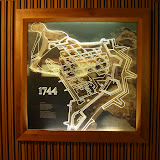
Another 3 hours this afternoon at another National Historic Site of Canada - the Louisbourg Fortress.  It was established as a french fortress, the frence having arrived in 1713.  It was named after King Louis 14th and built during the reign of Louis 15th. Louisbourg quickly became France's most importnt stronghold and seaport in what is now Atlantic Canada.  Later it was the scene of two decisive sieges between the English and French in 1745 and 1758. By 1760 it lay in English hands and its fortifications were destroyed.  James Wolfe (Westerham again) was the hero of 1758.  The Fortress today is the largest recontructed 18th century town in North America.

It was more role playing like the Citadel in Halifax but on a bigger scale.  The soldiers and townsfolk made conversation as though the tourists were players too.  Mostly we were greeted in french.  We were in deep trouble as soon as we opened our mouths!  It was explained that the date was 1744 and the whole town was on high alert because of fear of the arrival of the english.  The soldiers in particular were very cagey when talking to us and  suggested our freedom might be in jeopardy! 
Louisbourg Fortress
https://photos.app.goo.gl/Dyf8dxZ68Bd1rcUQ6

Tuesday, 22 June 2010

In National Park, incommunicado

Cabot Trail - click on the photo to see the other photos
https://photos.app.goo.gl/P995tD2qDFJ8x8FQ9

This evening, Monday, we finally received a text message sent by James wishing Steve a Happy Fathers Day.  It arrived so late because we had no mobile signal the whole time we were in the Cape Breton Highlands  National Park.  (Dark green section on the map on the last post)

We left our campground at Port Hood and resisted the distillery choosing to stop instead in Mabou where there is a very famous pub, The Red Shoe, which has live gaelic music every evening.  We were there at lunch time so the music was piped but Steve seemed to enjoy his Red Shoe pint.  Also in Mabou is a sweet little church, well a shrine actually - do look at the photos.

Joe's Scarecrows provided us with a light-hearted diversion.  We met Joe himself doing a bit of routine maintenance on one of his characters.  He asked where we were from and, hearing it was from the UK he said he had had a long visit from Billy Conolly who was going to include the scarecrows in a travelog he was making.  Has anyone seen it yet?

At Inverness Harbour we saw some more lobster boats being unloaded into another old fire truck.  When we came back from a walk along the very impressive Inverness beach a little rv had parked up beside us.  It was identical to the one we had in W Canada 2 years ago - we had been expecting something of a similar size this time before we were given the truck.  We have got used to the truck and appreciate the space and facilities when on campgrounds.  I suppose we're used to driving too, though I knocked a wing mirror of a pick-up on the ferry we had to go on today - no harm done thankfully.

The night before entering the National Park was spent at a good campground on Cheticamp Island.  Once more an Acadian area,  actually Cheticamp is supposed to be the largest settlement of acadians in N Americal at present (and also the rug hooking capital of the world...)  Apparently acadians were granted land there not long after the 'expulsion' of 1755.  The camp host explained that, although he was an acadian and spoke french, he, like all other Acadians, also speaks english and he is loyal to the Queen and personally looking forward to her visit to Nova Scotia next week.

Yesterday morning we paid our National Park fees, collected the warning literature about bears (black) and coyotes and set off.  It was our greatest hope that we would see moose - the campsite chap and the National Park staff said we would but sadly we haven't.  Lots of walks in places where they are supposed to frequent and all we saw was their massive footprints and plenty of 'poop'.  We didn't see any black bears or coyotes either.  The best we could do was several green frogs, located because of their croaking and a couple of red squirrels (both in campsites).  Vegetation has been slightly more interesting as we have seen insectivorous plants and also lady's slippers orchids.

The landscape in Cape Breton Island is more rugged than the rest of Nova Scotia that we have seen so far - the National Park particularly so.  Also pretty isolated.  There are mountains and most of the woods and forests are of various pines.

Tonight we are in Englishtown- a very small town with a wharf, church, fire station, post office and village hall with about 10 houses and a campground.  Tomorrow morning we are hoping to go on a 'Puffin Boat Tour' to see birds and seals.  We have to just turn up and they will run the trip if there are more than 5 people wanting to go on it.  Hopefully it will be a nice day and the sea will be calm again.

We have failed to go on another whale watching trip.  Either no boats because their owners are still lobster fishing or the wrong sort of boats.  Nevermind, we could hardly be as lucky again as we were off Digby Neck.

Thanks for your comments, keep 'em coming please.

To answer some outstanding questions - Colin, flowers in gardens I have seen here are very similar to those at home and so are the weeds.  We've just been admiring a beautiful patch of buttercups for example.  There is a mystery about Hostas here - they are very popular and never seem to have any holes in their leaves.  Perhaps there are no slugs or snails in NS. - Wendy, there are very few tourists doing the trails with us.  It has been slightly busier here on Cape Breton Island and there have been 4 or 5 overnight rvs at campgrounds rather than the 1 or 2 we've been used to.  All the locals we speak to say their real holiday period doesn't start until July.

Saturday, 19 June 2010

catch of the day better than match of the day!


Fox island to Port Hood

https://photos.app.goo.gl/8wuutTcbFqByBpD29

We are now at Port Hood on Cape Breton Island - site chosen with care for its internet availability and arrived at early enough for Steve to be able to enjoy (!) the England Algeria match this afternoon. 

It rained all day yesterday for our journey along the Eastern Shore (Turquoise on map) from Murphy's Cove to Fox Island, nr Canso.  The road surface was particulary bad and the roads were practically deserted.  We had to use another short ferry to cross an inlet but fortunately timed it pretty well and didn't have to wait for an hour!  Our biggest worry was that we would run out of fuel - the area is very remote and we drove for 120 miles looking for the next filling station!

Fox Island was a pretty spot, even in the rain and mist.  This morning it was sunny again - long may it continue so.  The area's main claim to fame is its straight line proximity to Europe and therefore its suitability for the landfall of trans-atlantic telegraph cables.  Gordon Bennett, of the New York Times was a partner in the cable company that brought in the cables to Fox Island, Canso and established a relay post there in 1876.

Once we had bought some very expensive petrol in Canso, we set off along the rest of the Eastern Shore for the causeway to Cape Breton Island (green on map above).  Before reaching the causeway we stopped at the 'Look-off' near Guysborough to read about the theory that Nova Scotia was discovered by one Prince Henry Sinclair of the Orkneys in 1398.  A bit further along we stopped for our 'picnic' in Eddy Point Marine Park to find that the lobster boats had just come in and crates of live lobsters were being loaded into a fire truck of all vehicles.

Cape Breton island is no longer an island as a causeway was constructed in 1955.  We are currently travelling round Cape Breton island in a clockwise direction up the Ceilidh Trail. The other language on road signs is now gaelic!  There's even a distillery...trouble is someone has to drive!

Thursday, 17 June 2010

British vs French

Fort Anne via Grand-Pre to Murphy's Cove

https://photos.app.goo.gl/8HJf9oLUjyYMZRam9

Before we left Annapolis Royal we did a tour of Fort Anne.  Our arrival was made more exciting by a sighting of some sort of brown, long bodied, furry tailed, shortish legged animal.  It ran from the Powder Magazine building over the fortifications towards the river/sea and then back round the main building and up and down another ditch towards some trees and the town.  A parks official was with us and thought it might be a mink.  It was bigger than  a big domestic cat.  Too quick and too distant for me to photograph sadly.
Fort Anne was interesting and had a bit of a British/Loyalist bias. 

After Annapolis Royal we drove the length of the Annapolis river valley.  The early french settlers (Acadians) had built dykes in the salt marshes to produce good quality farm land.  Too good really.  Nowadays there are a lot of hay fields and as you work further up the valley towards Grand Pre (Large meadow) the size of fields and the variety of crops increases.  This is quite a change from the rest of Nova Scotia where most of the land is covered in dense mixed woodland/forests.

We stopped the night at Evangeline Beach and saw first hand the extent of the enormous tidal range of the Bay of Fundy.  (See the photos in the above album)

This morning we visited the Grand Pre site.  This time the history was presented from an Acadian perspective and the exhibits and video presentations were in french with english very much second! 
It was the same story we have heard which basically boils down to Nova Scotia being in between New England (Boston Mass. area) and New France (Quebec area).  The french got there first, made friends with the local 'first nations' people, converted them to Roman Catholicism and set about farming, fishing and trading wood and furs and surplus crops.  Over the years Acadia changed between french and british rule and there were various battles.  The Acadians, according to today's presentation, were neutral.  However in the mid 18th century they were under great pressure to sign an oath of allegiance to Britain (and protestantism) and those who refused to do so (most of them) were forcibly deported in 1755 and their land, homes and belongings were confiscated.  New England 'planters', who were loyalists, were brought in and given the productive farms of the Acadians.  The Acadians were split up and sent to New England and some back to France.  Over the years some of them were able to make their way back to Nova Scotia but had to make do with poorer agricultural areas.  The Acadian flag ( a tricolour with a single star) flies bravely all through the areas of Yarmouth and Acadian Shores and Fundy Shore and Annapolis Valley.

Henry Wadsworth Longfellow wrote a classic poem about the 'deportation' called 'Evangeline: the tale of Acadie' which describes a fictional heroine, Evangeline and her search for loved ones after the deportation .

From Grand Pre we drove across the middle of Nova Scotia, back to the Halifax area and then east along the 'Eastern Shore'.  We have stopped at an idyllic spot near Tangier called Murphy's Cove.  Another stunning campground with suberb sea views and its own wharf/jetty.  Tonight we have enjoyed an evening around a campfire with Mr Murphy holding court and cooking complimentary mussells on the campfire.  He hauled a crate of them out of the sea and filled up a cooking pot and cooked them over the campfire.  Can't get much fresher than that!  Mr Murphy's family were from Ireland but have been here since 1750!  We asked about the mystery animal at Fort Anne and their suggestion is that it might have been a Marten but probably a 'fisher'.

A seal sometimes shows up for these nightly campfires but he was absent tonight unfortunately.